
Moral Panic

Don’t trust anyone who starts off an article saying ‘I think you’ll find it was Shakespeare who wrote….’
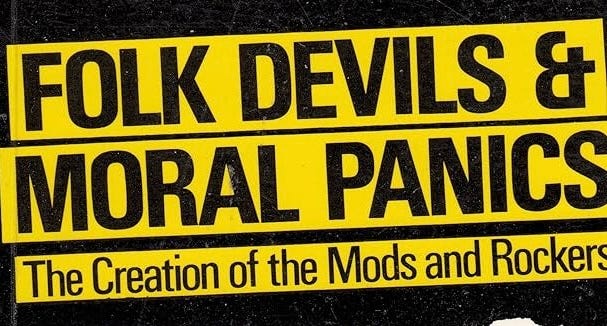
They will have googled it to impress. I was looking at the dreadful events in Minnesota and the phrase ‘moral panic’ came to mind. I remembered reading a book about it in my youth but I admit I had to look it up. ‘Folk Devils and Moral Panic’ by Stanley Cohen 1972 - that’s the one.
Moral Panic is an intense disproportionate public fear that a specific group, behaviour or sub culture threatens society’s core values. It is usually amplified by the media, politicians or what Cohen calls ‘moral entrepreneurs’. I had forgotten that his case study for the book was the bank holiday clashes of 1964 between the Mods and the Rockers. In Minnesota we see Trump’s obsession with scapegoating the Somali community although they make up less than 2% of the city’s population. This is only one of his many attempts to spread moral panic.
Moral panic has reared its ugly head in every generation. In the first half of the 20th century it was predominantly anti semitic, and not just in Nazi Germany. A turning point for this phase in the UK may have been ‘The Battle of Cable Street’. This was a series of clashes that took place at several locations in the East End of London, most famously Cable Street, on Sunday 4 October 1936. It was a clash between the Metropolitan Police, sent to protect a march by the British Union of Fascists led by Oswald Mosley and anti-fascist demonstrators organised by the Independent Labour Party, the Communist Party and the Jewish People’s Council. The anti-fascist counter-demonstration included both organised and unaffiliated participants. It is notable for showing the possibility of countering moral panic. While a few thousand came out to march with the fascists well over 100,000 joined the counter demonstration.
After World War 2 we entered what became known as the Cold War period and the fear of ‘reds under the bed’. This red scare was a form of moral panic provoked by a fear of the rise of left wing ideologies in society, Historically, red scares have led to political persecution and scapegoating. In the US we had Senator Joseph McCarthy and his crusade of McCarthyism hounding out ‘communist infiltrators’ in government military and Hollywood. Alongside McCarthy was the House Committee for Unamerican Activities pursuing a witch-hunt that ended careers, blacklisting thousands.
Another perceived threat to our core values and target for moral panic was the growing black population in Britain. ‘The Rivers of Blood Speech’ made by Enoch Powell in 1968 strongly criticised the rates of immigration from Commonwealth countries (former British colonies) and opposed the Race Relations Bill which criminalised the refusal of housing, employment, or public services to persons on the grounds of colour, race, or ethnic origin - “As I look ahead, I am filled with foreboding; like the Roman, I seem to see the River Tiber foaming with much blood”. This moral panic led to the extraordinary sight of east London dockers and Smithfield porters marching in support of Enoch Powell’s anti-immigrant views. The appeal of racism to traditionally left wing working class trade unionists can be explained by two things. It came at the end of a drawn out failed strike for better conditions and with living standards under massive pressure. It was also stirred up by anti immigrant infiltration exploiting their unrest. These were ideal conditions for the spread of moral panic.
This tactic of distracting people from their domestic problems is designed to foster a sense of unity and fear that they face a common enemy. We can see this going on in the UK today. Rather than focus on how to tackle our strained public services or post-Brexit economic malaise, some politicians channel public frustration toward migrants. Why not put the blame on the “boat people” living in hotels at taxpayer expense.
The Clacton-on-sea of the 1964 clash between mods and Rockers is now the constituency of the self styled saviour of Britain, Nigel Farage. But his “stop the boats to save Britain” is a false prospectus.
The young bikers of 1964 did not destroy our core values, nor will frightened families fleeing war and persecution. Yet moral panic can do real damage. It can erode our compassion, distort our politics, and lead to cruel policies that betray the very values we claim to defend. When we stoke up the fires of racism and prejudice (or even just pander to them) they are not easily extinguished. They leave division and hatred in their wake.
The lesson of Clacton’s history is that moral panic eventually subsides but how long does that take and what legacy does it leave behind.
I think you will find it was Stanley Cohen who wrote “You can close your eyes, close your ears, close your minds, close your doors, close your frontiers. Or you can open your heart” (and, yes, I had to google that)
.